
Wine Under The Stars
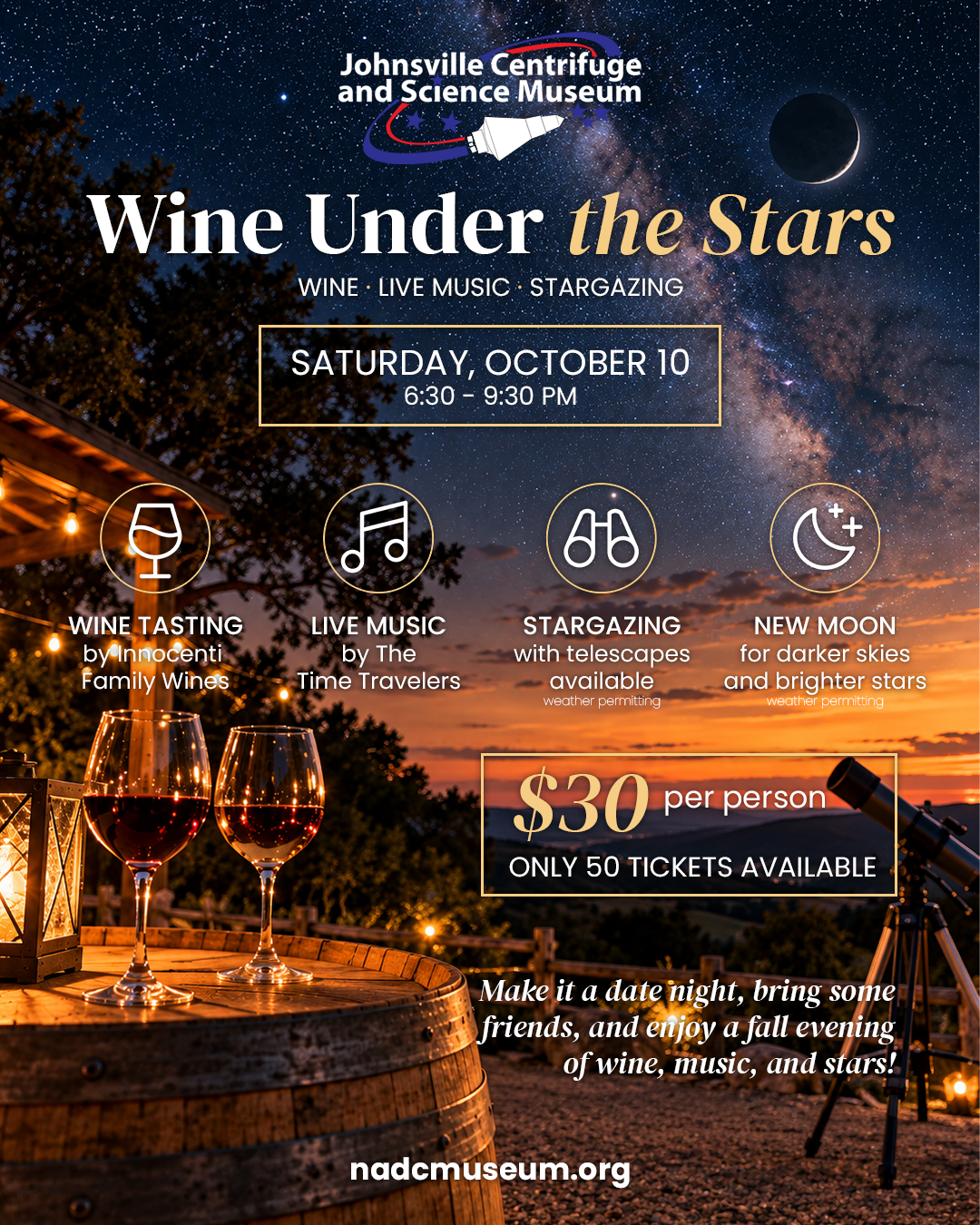
Join us for Wine Under the Stars at the Johnsville Centrifuge & Science Museum on Saturday, October 10 from 6:30 to 9:30 PM. This special evening will feature a wine tasting from Innocenti Family Wines, live music by The Time Travelers, and stargazing with telescopes available throughout the night, weather permitting. With a new moon creating darker skies, guests will have an excellent opportunity to take in the stars while enjoying the atmosphere of the museum grounds.
Whether you are planning a date night, meeting up with friends, or simply looking for something different to do this fall, Wine Under the Stars offers a unique combination of wine, music, and astronomy in one memorable evening. Tickets are $30 per person and attendance is limited to just 50 guests, so advance reservations are strongly encouraged. Food will also be available, with additional details to be announced.
Visit Us
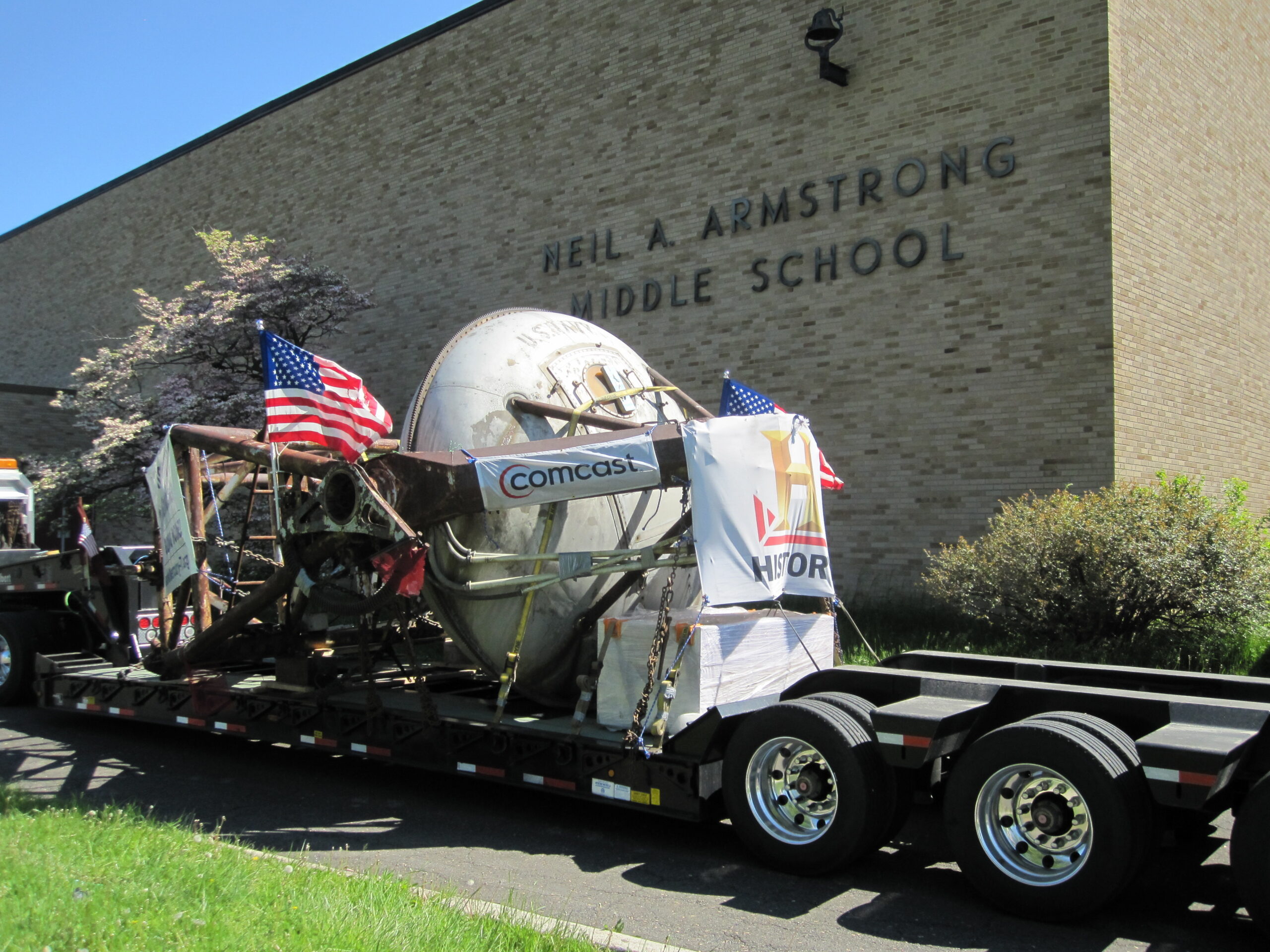
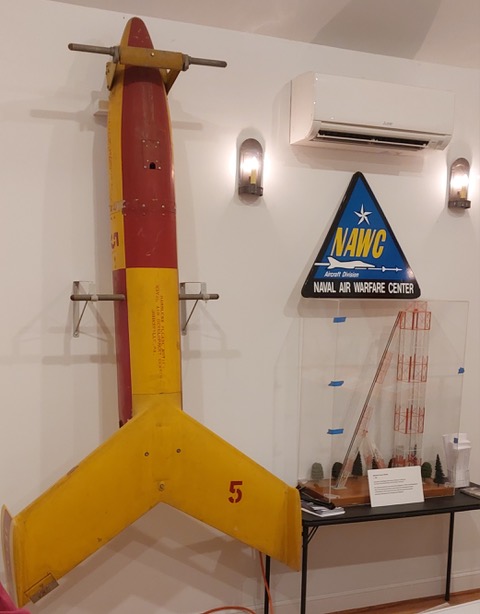
Our exhibit space is currently located at the John Fitch Steamboat Museum, 599 Newtown Road in Warminster, Pennsylvania, where the Iron Maiden and other important NADC artifacts are on display.
The museum is open to the public from Noon to 3 PM on the second Sunday of each month.
Private group tours and STEM classroom experiences are also available by appointment.
NADC History
Our organization is dedicated to preserving the history of the Johnsville Naval Air Development Center (NADC), its groundbreaking research laboratories during the Cold War, and our region’s important contributions to the United States space program. This work is led by our History and Exhibits Committee, also known as the NADC Historical Society.
The story of NADC began in 1939, when the Brewster Aircraft Company acquired farmland in Warminster. By 1941, a factory was operating on the site, producing the company’s Buffalo Fighters and Buccaneer Dive Bombers for the United States Navy during World War II. After Brewster experienced production difficulties, the Navy assumed operational control. By the end of the war, the Navy had acquired the property outright and converted it for use by the Naval Aircraft Modification Unit (NAMU), a division of the Naval Aircraft Factory.
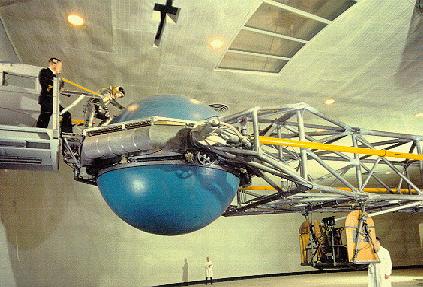
Following World War II, the production facilities were transformed into advanced research laboratories focused on pilotless aircraft, electronics, and weapons systems. The installation was renamed the Naval Air Development Station (NADS), Johnsville. One of the most significant developments during this period was the construction of the human centrifuge facility, which began in 1947 and was completed in 1949. The centrifuge was used to study the limits of human tolerance to G-forces and later played a crucial role in training astronauts from the Mercury, Gemini, and Apollo programs, as well as early Space Shuttle crews.
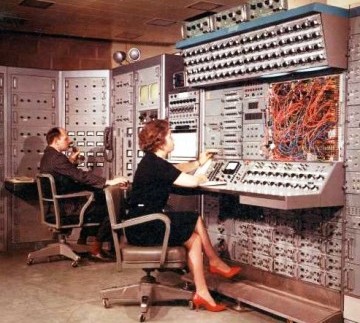
Over the following decades, the facility evolved alongside new missions and technological advancements. The site was eventually renamed the Naval Air Development Center (NADC) Johnsville, and later the Naval Air Warfare Center (NAWC) Warminster. At its peak, more than 31 research laboratories operated at the Warminster site, studying areas such as navigation systems, submarine detection, aerospace materials, aircraft structures, pilot equipment, computers, airborne photography, and aircraft instrumentation.
Scientists and engineers at NADC averaged nearly fifty patents per year, contributing to technologies that continue to impact everyday life. Innovations developed at Warminster include flight data recorders (aircraft “black boxes”), fire-retardant textiles, self-tinting photo-gray lenses, pilotless aircraft technology, advancements in heart catheterization, and elements of modern GPS systems.
NADC continued operations until 1996, when most of its functions were transferred to the Naval Air Station Patuxent River in Maryland. The famous Johnsville human centrifuge remained operational until 2004, marking the end of one of the most unique aerospace research facilities in American history.
Mission and Purpose
The mission of the Johnsville Centrifuge and Science Museum is to provide a world-class educational and entertaining environment for the study of aerospace sciences, where learning is an inspirational experience.
PURPOSE
Our stated purpose is to establish, maintain, and operate a premier science museum to serve the community by providing a learning center for studying Aerospace Science and related topics. We will endeavor to educate and inspire the youth, enlighten the population and entertain its seniors. We will acquire, restore, preserve, and protect NADC-related items and archives. We will do these things in an ethical, fiscally responsible, and ecologically sensible manner.
WE HAVE SIX PRIMARY OBJECTIVES
- Provide the young with a center of learning specializing in science and history. Planned topics include astronautics, aeronautics, biomedical studies, flight simulation, software and physics.
- Honor the early astronauts and their heroic deeds.
- Provide seniors with a place they can experience and engage in stimulating activities.
- Preserve the contributions of the NADC Alumni and local population towards the development and advancement of the US Space Program.
- Preserve for future generations the drawings, documents, photographs, oral histories and film archives of Brewster, NAMU, NADC and NAWC.
- Provide a public model of sustainable energy efficiency and green technology in a commercial setting.